
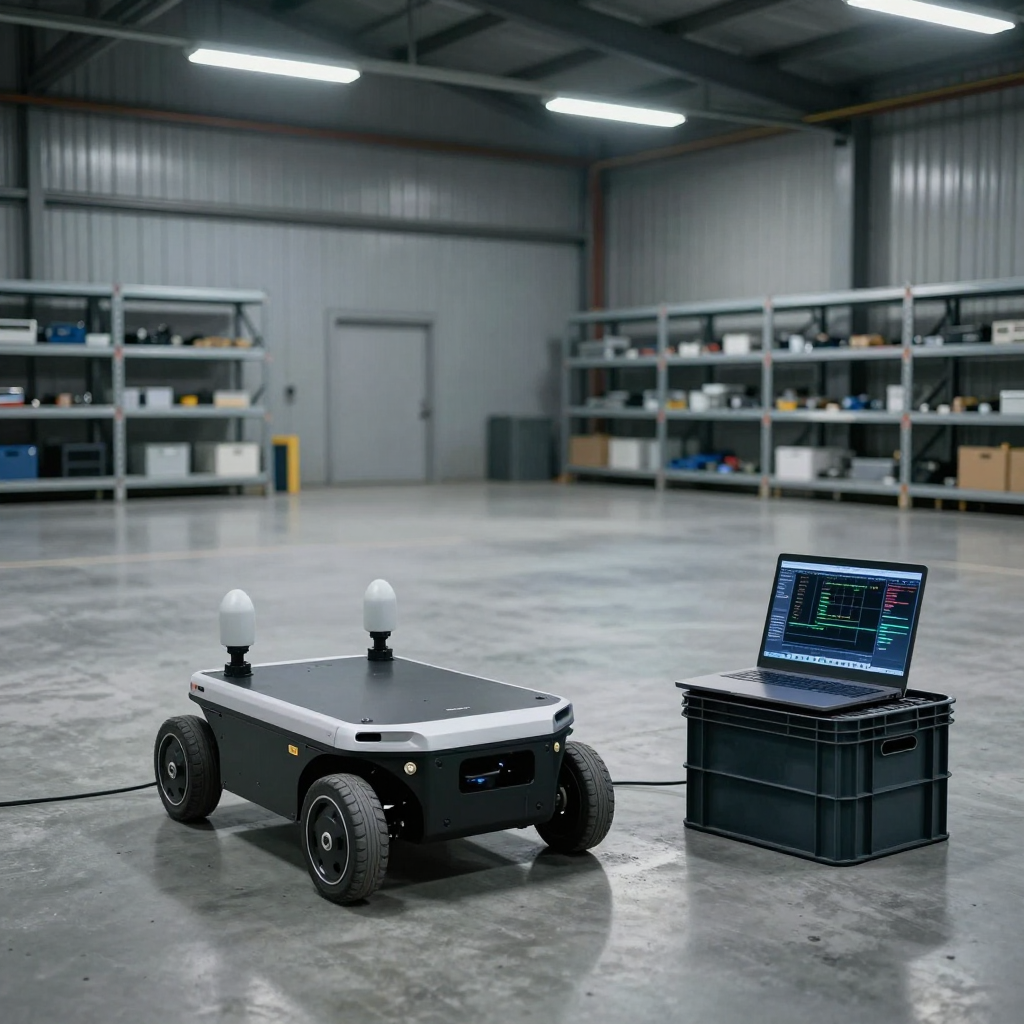
I’ve been working with GNSS for long enough to remember when getting a reliable heading meant babying a magnetometer and praying there wasn’t a steel beam anywhere nearby. A couple of years ago, we were testing an autonomous warehouse rover in a hangar—cold, echoey, full of metal shelving. The heading kept drifting, sometimes by 15 degrees or more. We swapped cables, updated firmware, tweaked filters. Took us three days to realize the problem wasn’t the code. It was the shelving. Magnetometers just don’t work around ferrous metal. You can’t filter your way out of physics.
That experience stuck with me. So when u-blox announced the ZED-X20D, I paid attention. Not because it’s another shiny module, but because it finally addresses the thing that’s been causing headaches for years: the compass.
The new module supports all major GNSS constellations—GPS, GLONASS, Galileo, BeiDou—across L1, L2, L5, and L6 bands on both antennas. That “both antennas” part is worth emphasizing: some dual-antenna solutions compromise by using different bands for each antenna, which affects accuracy. The X20D treats both antennas equally, so you get the same signal quality for heading calculation regardless of orientation.
L5 matters more than most people realize. It was designed for safety-of-life services, so it has better signal structure and more power than L1. In practical terms, that means it holds lock under tree canopy, near buildings, or in multipath-heavy environments where L1 gives up. I’ve watched L1 signals fall apart under a walnut orchard; L5 just keeps going.
L6 opens up access to correction services without extra hardware. The module supports Galileo’s High Accuracy Service (HAS) directly, which is free and broadcast through the Galileo E6 signal. You can also use u-blox’s PointPerfect service for PPP-RTK corrections if you need regional or global coverage. That means centimeter-level positioning without setting up a base station or relying on cellular coverage. For anyone who’s spent an afternoon troubleshooting an NTRIP connection in the middle of a field, that’s a real quality-of-life improvement.
The “D” in X20D stands for dual antenna, and it gives you instantaneous heading from two antennas. No drift. No magnetic interference. No calibration. It works whether you’re moving at 50 km/h or sitting still. That matters more than you might think—single-antenna systems can’t determine heading at low speeds, which is why so many autonomous vehicles end up relying on magnetometers despite their well-documented fragility.
The X20D calculates heading directly from the carrier phase difference between the two antennas. It’s a solved problem, but until now it required separate receivers or complex integration. Having it in a single module simplifies the bill of materials considerably.
The module comes in the same ZED form factor as the F9P—17 x 22 mm—so if you’ve designed around that before, the mechanical integration is already done. Temperature range is -40°C to 85°C, covering most industrial applications without needing special enclosures. Power supply accepts 3.0 to 3.6 V, typical for this class of device.
Engineering samples are supposed to land in Q2 2026, with ZED-X20D evaluation boards available starting in April (datasheet). If you’re currently using an F9P and want to test the upgrade, the pinout compatibility should make that relatively painless.
I’ve used the ZED-F9P board in the past, including on a survey project in the Pyrenees where the weather changed faster than we could log data. It was solid. The X20D feels like the next step: same reliability, but with the orientation problem finally solved. It won’t make sense for every project—if you’re building a simple GPS logger, this is overkill—but for anything that needs to know which way it’s facing without fighting magnetic interference, it removes a whole category of headache.
If you’re dealing with heading drift or magnetometer noise in your own builds, I’d be curious to hear what you’ve tried. Always interested in how others are solving these problems.