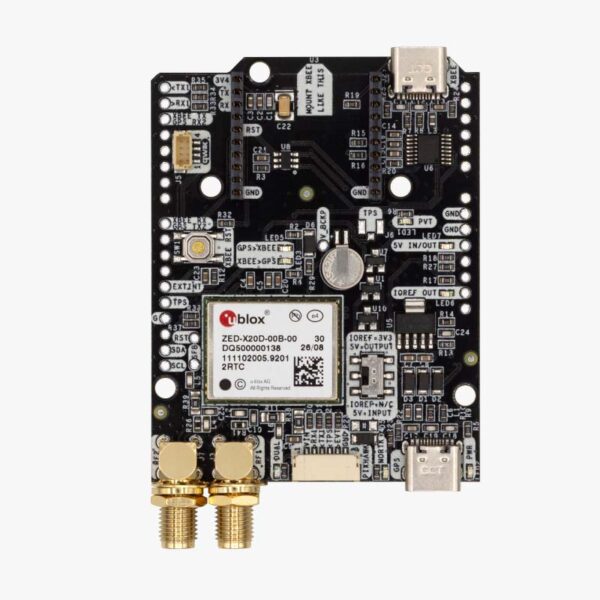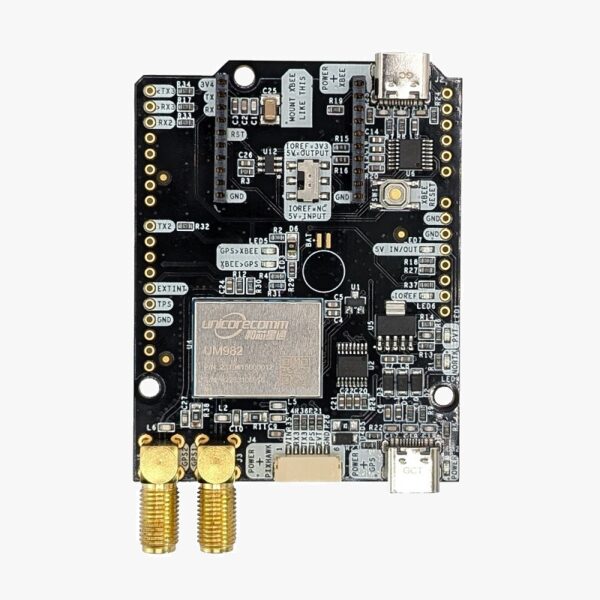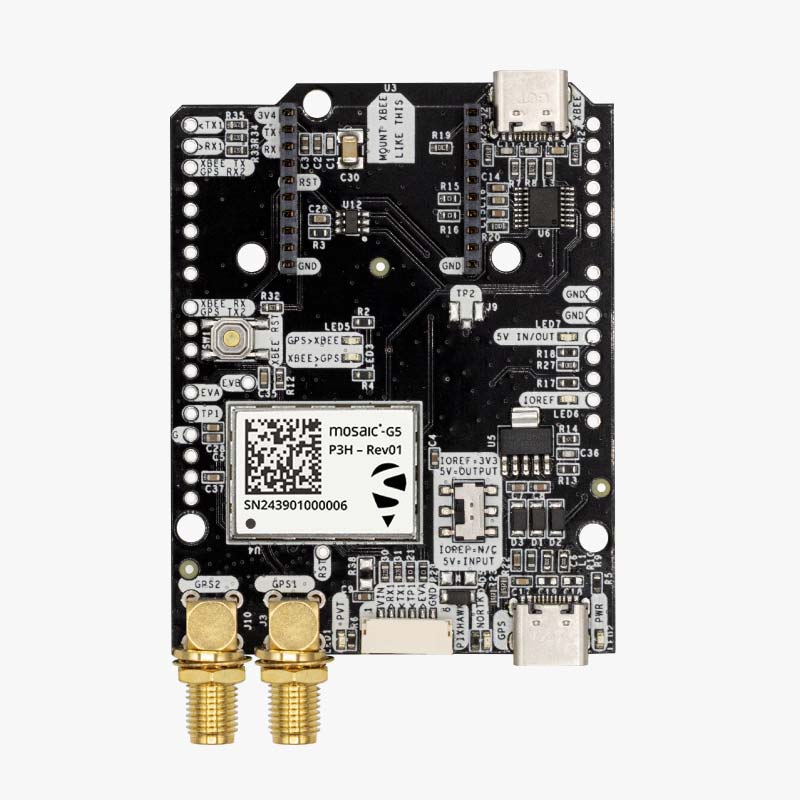
Here is a side-by-side comparison of the three recommended dual-antenna modules. All three provide centimeter-level RTK positioning and GNSS-based heading (yaw) that works even with short antenna baselines (as low as 50 cm). They also support roll and pitch output in dual-antenna mode.
Get centimeter-level RTK positioning and high-accuracy attitude (heading, roll & pitch) from GNSS satellites — even with antennas only 50 cm apart.
🧪 We tested all three modules ourselves — on a DIY drone platform with a 60 cm antenna baseline, flying in three environments: open field, urban canyon, and near a 5G tower. The table below shows official specs, but here’s what we measured in real flights:
Achieve sub-degree heading accuracy without magnetometers. Reliable orientation in both static and dynamic conditions. Perfect for drone stabilization, autonomous navigation, wind compensation, and robust flight control.
| Feature | u-blox ZED-X20D  | Unicore UM982 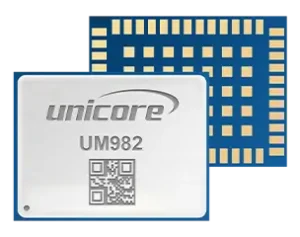 | Septentrio mosaic-G5 P3H 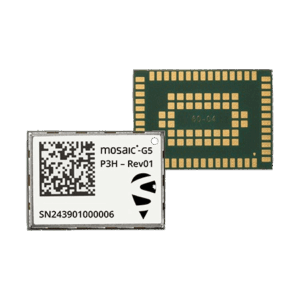 |
|---|---|---|---|
| GNSS Bands | All-band (L1/L2/L5/L6 + L-band) | Triple-band (L1/L2/L5) | Triple-band (L1/L2/L5) |
| Multifrequency and Multiconstellation | GPS: L1C/A L2C L5 Galileo: E1-B/C E5a E6 Glonass: L1OF L2OF BeiDou: B1I B1C B2a B3I QZSS: L1C/A L2C/B L2C L5 Navic: L1-SPS L5-SPS SBAS: WAAS, EGNOS, MSAS, GAGAN and SouthPAN | GPS: L1C/A L1PY L2C L2PY L5 GLONASS: L1CA L2CA L2P L3 CDMA Galileo: E1 E5a E5b E5 E6 HAS BeiDou: B1I B2I B3I QZSS: L1C/A L2C L5 Navic: L5 SBAS: WAAS, EGNOS, MSAS, GAGAN, SDCM (L1) | GPS: L1C/A L2C L2PY L5 GLONASS: L1CA L2CA L2P L3 CDMA Galileo: E1 E5a E5b EE6 BeiDou: B1I B1C B2a B2I B2b B3I QZSS: L1C/A L1C/B L2C L5 L6 Navic: L5 SBAS: WAAS, EGNOS, MSAS, GAGAN, SDCM (L1 L5) |
| Channels | 1344 channels | 1408 channels | 789 channels |
| Accuracy with NTRIP | < 1 cm (up to 35 km) Horizontal: < 1 cm + 1 ppm | < 1 cm (Millimeter level) Horizontal: 0.8 cm + 1 ppm | < 1 cm (Millimeter level) Horizontal: 0.6 cm + 0.5 ppm |
| Accuracy with SSR | 0.14° | 0.1° – 0.2° | 0.15° |
| Accuracy with SBAS | < 0.9 m | < 0.6 m | < 0.6 m |
| Standalone Accuracy | < 1.5 m | < 1.2 m | < 1.2 m |
| Default Update Rate | 1 Hz | 1 Hz | 1 Hz |
| Maximum Update Rate | up to 25 Hz | up to 20 Hz | up to 20 Hz |
| GNSS Attitude Accuracy | 1 m antenna separation: 0.14° heading, 0.23° pitch/roll 5 m antenna separation: 0.03° heading, 0.05° pitch/roll | 1 m antenna separation: 0.14° heading, 0.23° pitch/roll 5 m antenna separation: 0.03° heading, 0.05° pitch/roll | 1m antenna separation: 0.15deg heading, 0.25deg pitch/roll 5m antenna separation: 0.03deg heading, 0.05deg pitch/roll |
| Start-up Times | First position fix: 25 s (cold), 2 s (hot) Warm start: < 10 s First RTK fix: 35 s (cold) | Cold start: < 35 s Warm start: < 10 s Re-acquisition: 1 s | Cold start: < 45 s Hot start: < 20 s Re-acquisition: < 1 s |
| Base and Rover Functionality Support | Base + Rover | Base + Rover | Rover |
Our take: For 90% of drone applications, the Unicore UM982 is more than enough. But if you fly near infrastructure or need bulletproof reliability, the Septentrio is worth the premium. The u‑blox ZED‑X20D is the safest all‑rounder – especially if you plan to scale to production.
All three dual-antenna GNSS modules deliver centimeter-level RTK positioning and sub-degree GNSS-based heading (yaw), with roll and pitch output, even when the antenna baseline is as short as 50 cm. They eliminate the need for magnetometers in many cases and provide reliable attitude information in both static and dynamic conditions.
Key technical differences:
Target applications (common to all three):
Who is each module best suited for?
Practical conclusion:
For most drone developers, the Unicore UM982 or u-blox ZED-X20D will provide the best balance of performance, size, power, and cost. Start prototyping with our simpleRTK evaluation boards to test them quickly. If your drones operate in high-interference zones or require the highest possible robustness, go with the Septentrio mosaic-G5 P3H.
Notes:
Start testing today with our ready-to-use boards: (we used the same boards for our flight tests above):
All boards are ArduPilot & PX4 compatible and include USB + documentation.
Need help choosing the right module for your specific drone platform or payload?